California designates Bruce Lee Day, first such honor for a Chinese American
Published in News & Features
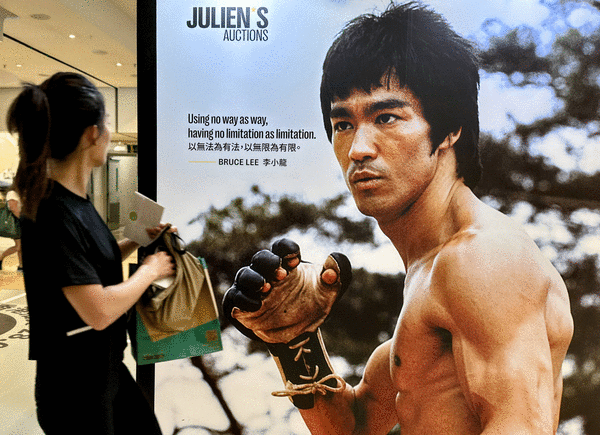
Cut to a seedy alley behind a Chinese restaurant in Rome: A dozen mobsters menace a slight young man who suddenly pulls out a pair of nunchucks. He swings the traditional stick-and-chain weapons and makes quick work of his enemies, who fall one by one, groaning in pain.
The comedic, legendary action scene is from the 1972 film “Way of the Dragon,” written, directed and starring Bruce Lee. The martial arts star was a trailblazer, allowing Asian Americans to see themselves represented in a strong, positive light on screen.
And now he has secured a place in California history, becoming the first Chinese American in state history to have a day designated in his honor.
Lee was born in 1940 in San Francisco. His mother was of European descent and his father was a Cantonese opera star who was on tour in the city, affording his son birthright citizenship.
Lee grew up in Hong Kong, where he followed his father’s path as a performer, acting in more than a dozen films as a child and studying the close-quarters southern Chinese martial art Wing Chun.
On May 17, 1959, an 18-year-old Lee returned to San Francisco and eventually made his way to Hollywood. He went on to influence an industry that was at the time bereft of Asian American talent, and helped to popularize the genre of martial arts films and ignite Western interest in Hong Kong action cinema.
In recognition of his contributions, state Assemblymember Matt Haney, a Democrat, introduced a bill designating May 17 as “Bruce Lee Day” in California. The bill, signed into law Tuesday by Gov. Gavin Newsom, encourages schools and communities to honor Lee’s life and cultural influence.
Haney has described Lee as a “symbol of pride, resilience, and possibility for generations who rarely saw themselves reflected with strength and dignity.”
Lee, who saw himself not only as an actor but also as a poet and philosopher, encountered repeated barriers. Up for the main role in the 1970s television series “Kung Fu,” for example, he was rejected in favor of white actor David Carradine.
In 2020, filmmaker Bao Nguyen sought to show how Lee dispelled anti-Asian sentiment and long-held stereotypes of emasculated Asian men in his ESPN documentary “Be Water.”
“The Asian male was the face of the enemy to many Americans,” Nguyen told the Los Angeles Times in 2020. “It was this vicious cycle of society reflecting media and culture, and media and culture reflecting society. There had to be some kind of intervention there and Bruce, in a way, was that intervention. He was the hero that we hadn’t seen before.”
Lee learned much about the systemic oppression that Black Americans faced from his first student, Jesse Glover, who had been a victim of police brutality.
And scholars have pointed out that, although his films had far-from-perfect politics, they touched on themes of fighting oppression. The 1971 movie “The Big Boss” showed Lee battling alongside laborers. “Fist of Fury” saw him opposing Japanese colonialism and discrimination.
Lee died young in 1973, at age 32 — before he was able to witness the full extent of his stardom. He died just one month before the release of “Enter the Dragon,” which was a box office sensation and is considered a masterpiece of martial arts filmmaking.
©2026 Los Angeles Times. Visit at latimes.com. Distributed by Tribune Content Agency, LLC.





Comments