Campaign to repeal Washington 'millionaires tax' submits more than 500,000 signatures
Published in News & Features
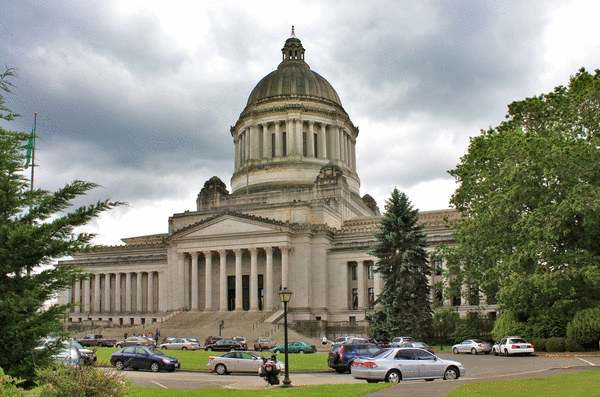
TUMWATER, Wash. — Opponents of Washington’s new high-earners income tax submitted more than 500,000 signatures for an initiative to kill the tax Thursday, setting up an epic brawl for November over the state’s tax system, government funding and business climate.
Initiative 645 would repeal the recently passed 9.9% tax on adjusted gross income of more than $1 million a year for Washington households, eliminating what Democrats have labeled the “millionaires tax.”
Backers of the initiative, led by Redmond hedge fund manager Brian Heywood, gathered at the secretary of state’s office Thursday afternoon, submitting 511,408 signatures in favor of I-645, almost certainly securing the measure a spot on the Nov. 3 ballot.
About 75 people gathered at the state secretary of state’s office, where Let’s Go Washington staff and volunteers unloaded boxes of signatures from a pickup truck. Flanked by stacks of petitions, Heywood told those assembled that voters around the state are rightfully distrustful of promises that the tax will remain only on the very rich.
“Not one single person we talked to believes Olympia when they say it’s not coming for them. They know it’s coming for them,” he said.
Also speaking against the tax and Washington’s broader political climate was investment executive Zach Abraham, Yakima resident and former farmer John Huibregtse and Greg Lane of the Building Industry Association of Washington.
Lane said lawmakers in the Democratic-controlled Legislature “have an insatiable desire to spend more and more and more.”
“Every time they come into session they have a budget deficit that they’ve created by their spending, and then they don’t consider cuts,” he added. “All they go is directly to what taxes they’re going to increase.”
Opponents blasted I-645 as a destructive proposal that would slash funding for schools, healthcare and a swath of other state services.
“The fundamental issue at stake here is that Brian Heywood and a group of his millionaire friends are trying to give themselves a tax cut at the expense of working people,” said Rian Watt, executive director of the Economic Opportunity Institute, a progressive nonprofit group.
Washington is one of nine states without a personal income tax, leaving it reliant on sales taxes that are comparatively hard on poorer residents.
Watt called I-645 “fiscally irresponsible” because it would repeal the new income tax on the state’s wealthiest residents while leaving in place tax cuts aimed at middle and lower-income people that were included in the “millionaires tax” deal signed into law by Gov. Bob Ferguson.
That would blow a $13 billion hole in the state budget over four years, Watt said.
Heywood said Democrats who run state government have spent their way into budget problems the new tax won’t fix. “They could take everybody’s money and it still wouldn’t be enough to pay for everything they want to pay for,” he said.
Opponents of the initiative include public sector unions, which have already poured about $200,000 into Millionaires Tax for Washington, the campaign to fight the proposal. That’s a modest downpayment on a campaign that could see spending in the tens of millions of dollars.
In a statement Thursday, Larry Delaney, president of the Washington Education Association, said I-645 would “take money from our schools and send housing and healthcare costs skyrocketing.”
The new high-earners income tax is expected to raise $3 billion to $4 billion a year starting in 2029, with most of the proceeds devoted to the state operating budget, which funds K-12 schools, universities, healthcare, prisons, the foster care system and other services. A 5% slice is dedicated to childcare and early-learning programs.
Some of the new tax money will also be sent back to Washingtonians in the form of tax breaks for small businesses and residents. The new law also makes 460,000 additional households eligible for the state Working Families Tax Credit, which gives out annual sales tax rebate checks of between $330 and $1,330.
State Senate Minority Leader John Braun, a Republican, dropped by Thursday to watch the signature turn-in. He said voters in Southwest Washington had been coming up to him to complain about the new tax.
“We’re still not in a recession, revenue is still growing in the state of Washington. We can absolutely still deliver essential services to the citizens of the state with the revenue we have,” Braun said before the event started.
To qualify for the ballot, I-645 needs 308,911 signatures from registered state voters. The massive turn-in of signatures Thursday gives the campaign a big cushion in case some signatures are found to be duplicates or otherwise illegitimate.
It will likely take about two weeks for the signatures to get checked and verified, said Stephanie Randolph, a spokesperson for the secretary of state’s office.
The last income tax plan to go before voters got crushed.
In 2010, Initiative 1098 proposed a 5% tax starting on individual incomes above $200,000, rising to 9% for earnings above $500,000. The initiative also would have cut the state property tax by 20% and lowered small business taxes. Just 34% of voters backed that proposal, which was defeated even in King County.
It was the 10th time Washington voters have said no to a state income tax since 1934.
Backers of the new tax hope this time will be different, pointing to the state’s increasingly liberal and Democratic-leaning electorate, and to growing public support for taxing the wealthy.
They flagged a poll they commissioned last month that showed 57% opposition to the income tax repeal initiative among voters who were read the initiative as it will appear on the ballot, including an “impact statement” stating I-645 it “would decrease funding for K-12 education, healthcare, human services, and higher education.”
In 2024, voters overwhelmingly rejected a Heywood initiative that sought to repeal the state’s new capital gains tax, which taxes stock and other investment profits for the state’s wealthiest residents.
In addition to the initiative challenge, some business owners have sued the state over the new tax, citing a 1933 state Supreme Court ruling which found that income is property that can only be taxed under the state constitution at a low flat rate. That precedent has stood for nine decades.
But Democrats and some legal experts have long argued that the 1933 decision was incorrect, leaving Washington an outlier among states on tax policy, and hope the state Supreme Court will overturn it.
Braun and Heywood suggested that Democrats structured the new law’s passage so that it needed to be challenged as an initiative instead of a referendum in order to make the vote more confusing.
“So they got to vote yes to repeal, instead of no on the tax,” said Braun. “But if voters understand how they’re voting, I think this thing gets repealed.”
©2026 The Seattle Times. Visit seattletimes.com. Distributed by Tribune Content Agency, LLC.





Comments