Mike Vorel: Reasons US World Cup star Folarin Balogun's red card doesn't sit right
Published in Soccer
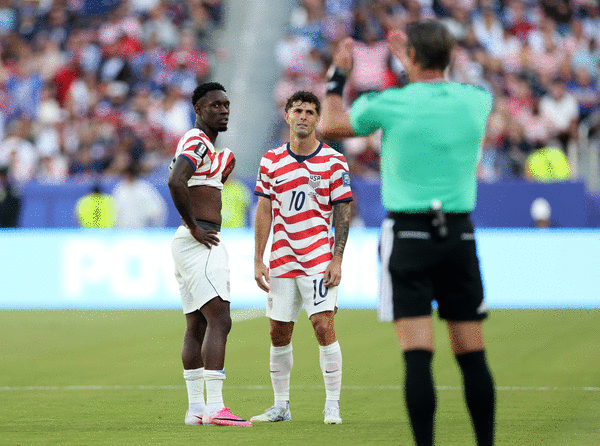
SEATTLE — That red card doesn’t sit right.
Not just because Seattle soccer fans will be deprived of the brilliance of Folarin Balogun, who was sent off in the 64th minute of the United States’ 2-0 FIFA Men's World Cup win over Bosnia-Herzegovina on Wednesday. Not just because the 24-year-old forward has emerged as an irreplaceably potent finisher, a rarity for a host country in constant search of stars. Not just because the U.S. must now defeat Belgium inside Seattle Stadium on Monday without its top goal scorer, whose red card carries a suspension for (at minimum) the round of 16 match.
It doesn’t sit right because of both the call and the consequences.
Regarding the call: at first, there wasn’t one. When Balogun collided with Bosnia-Herzegovina’s Tarik Muharemović while battling for the ball, then landed unintentionally on the defender’s ankle, play initially continued without a foul call. The video assistant referee then initiated a review for a possible “serious foul play,” providing Brazilian referee Raphael Claus with slow-motion footage.
Which, of course, made Balogun’s misstep look more menacing than it was in real time.
“If the call on the field was what it was, which was nothing, then you cannot — according to the VAR protocols — use slow motion still images,” Apple TV MLS analyst Taylor Twellman told Yahoo Sports on Thursday. “So they did not follow the right VAR protocol. That’s a fact. That’s not even my opinion.”
My opinion? VAR should receive a retroactive red card.
But that’s part of the problem: the opinions of subjective referees and inconsistent application of VAR reviews create contradictory rulings. In an opening-round win over Algeria, Argentina striker (and living legend) Lionel Messi unmistakably stepped on an opposing player’s calf. The infraction was clearly comparable to Balogun’s “serious foul play.”
No foul was given. No review was initiated. No red card was presented, possibly shifting the trajectory of an entire tournament.
Yes, that sounds dramatic. But remember that Messi scored all six of Argentina’s goals in the reigning World Cup champion’s three group stage wins.
If Messi did not deserve a booking, then neither did Balogun.
“The hardest thing about our sport in the world is that there are so many different ways to interpret the game,” Twellman said. “A South American referee looks at it different than an Asian referee, versus a European versus an American. So there’s a different way to interpret the game. But if Lionel Messi is not given a foul or a yellow card for his challenge against Algeria in the opening game, then unequivocally you cannot give a red card for this one.”
And yet, this potentially ruinous red card cannot be retracted. The U.S. cannot appeal the decision, though FIFA could theoretically extend the suspension upon review.
Credit the Americans for withstanding the storm Wednesday, and actually adding a goal while down a man for more than 30 minutes. But that storm will follow the stars and stripes to Seattle.
The consequences, for an American sports fan, seem inconceivable. In American football, an ejection doesn’t require the offending team to play minus a middle linebacker for the remainder of the game. In baseball, if Julio Rodríguez is tossed for arguing balls and strikes, the Mariners don’t go forward with a gargantuan gap in center field. Heck, if two hockey players repeatedly punch each other in the face, they sit for five minutes, then return to the ice.
Even an egregious, second-half targeting penalty in college football — say, for forcible contact to the head of a defenseless player — earns an ejection only for the first half of the following game.
Yet Balogun’s literal misstep — which didn’t result in any injury — warrants an ejection, a damning numbers disadvantage and an additional suspension?
I know, it’s futile to bemoan rules that have been in place since before I was born. But even so, I’ll say it:
That’s a preposterous punishment for a misplaced cleat.
Or, as sports writer Rodger Sherman posted Wednesday on X: “There should be some sort of other punishment for when someone commits a foul that was maybe bad but isn’t worth ejecting him from the game and the next game. Like some sort of card that isn’t red.”
A yellow card would have been fair. A red card may be fatal.
Because the Americans may need Balogun to beat Belgium.
Case in point: the 2014 World Cup, when these two teams met in the round of 16. In the final minutes of regulation, still scoreless, a crossing header found American striker Chris Wondolowski’s foot. With a point-blank look, Wondolowski belted the ball above the cross bar, and the U.S. fell 2-1 in extra time.
A capable, confident finisher makes all the difference.
As can, inversely, a catastrophic red card.
“I watched it after on TV and never was the intention to step (on) the player,” U.S. coach Mauricio Pochettino said, defending Balogun, who has scored three goals in three World Cup games. “That was a normal action in football that happened by accident. It was never intentional. That’s why for me it’s never a red card.”
It never should have been. But Team USA will be without Balogun on Monday anyway, needing to best Belgium to reach its first World Cup quarterfinal since 2002. The stakes, for a suddenly and stunningly soccer-crazed country, are as significant as the opportunity.
Let’s hope, this time Tuesday, the soccer is the story — and not the referees.
____
© 2026 The Seattle Times. Visit www.seattletimes.com. Distributed by Tribune Content Agency, LLC.





Comments