Mexico, Canada get exemption to 10% US levy but USMCA risk looms
Published in Political News
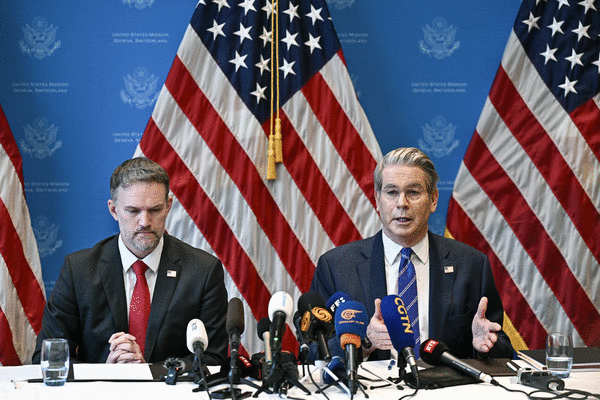
The U.S. Supreme Court’s decision to strike down many of Donald Trump’s tariffs offers some relief to Mexico and Canada, but a much bigger set of risks still hangs over the trade relationship that joins the three countries.
The president said in the afternoon the U.S. would impose a 10% levy on foreign goods under a different law. It took several hours before the White House clarified it’s leaving in place an exemption for many goods shipped under the U.S.-Mexico-Canada Agreement.
That exemption means the effective tariff rate for Canada and Mexico will decline. Until the court decision, products that didn’t qualify for the USMCA exemption were taxed at 35% if from Canada and 25% if from Mexico.
For Mexico and Canada, the events provided more proof of the value of the tripartite trade deal, which was signed during Trump’s first term. But the president’s frustration over the court’s decision also raises the risk he may try to radically alter or even blow up USMCA altogether in pursuit of the tariff revenue he wants.
The USMCA carve-out exemption allows the U.S. to continue to import oil and other resources from Canada and Mexico tariff-free, and avoids greater disruption in the trade of key manufacturing inputs such as automotive parts. U.S. Trade Representative Jamieson Greer, when asked about existing exemptions, said the White House was seeking “continuity” with the new tariff order, which will take effect on Feb. 24, the day Trump delivers his State of the Union speech to Congress.
Both countries were cautious in response to the Supreme Court’s decision. Mexican Economy Minister Marcelo Ebrard said he planned to reach out to his counterparts in Washington and to travel to the U.S. next week to address trade issues.
Dominic LeBlanc, the Canadian minister for U.S. trade, said the justices’ ruling reinforced Canada’s position that tariffs under the U.S. International Emergency Economic Powers Act were “unjustified.” But the government in Ottawa said little else.
Punishing tariffs are still in place on steel, aluminum, cars and other categories. And Mexican and Canadian officials know that even if using IEEPA is out, the Trump administration is ready to employ other tactics to gain an edge over them.
“The president didn’t lose his leverage, he just lost a lever,” said Barry Appleton, a trade lawyer who has advised governments including the Canadian provinces of Ontario and British Columbia.
Now, he said, “we’re going to see weaponizations of a variety of different tools that were never, ever conceived of in that way, utilized in that fashion, because the president does not want to go to Congress.”
Before Friday’s development, the effective U.S. tariff rate on Canadian goods stood at around 3.7%, according to estimates from Desjardins economist Royce Mendes. For Mexican products, the effective rate was about 4.4%, according to Grupo Financiero Base. It will be slightly lower for both.
But Trump has long loved tariffs, for economic and foreign policy reasons, and he’s not about to give that up.
“The Trump administration has a huge arsenal of trade tools, but we don’t know is what’s going to happen with Mexico and Canada,” said Diego Marroquin, a fellow at the Washington-based Center for Strategic and International Studies. “The Trump administration could expand section 232, and in that case there’s going to be an increasing number of Mexican and Canadian exports subject to tariffs.” That’s the part of U.S. trade law being used for the metals and automotive tariffs.
During his news conference, Trump cited the loss of automotive jobs as one of many reasons for his tariff policy. “We used to make cars. We made all the cars. And then Mexico came, and Canada came, and Japan and Germany,” he said.
Marroquin said it may become harder for the three countries to successfully extend the USMCA. The deal is up for review this year and the White House has made it clear it wants changes. Trump has privately asked aides why he needs to keep the pact going, Bloomberg has reported.
“It is basically putting more wood to the fire,” Marroquin said. “It is making it more painful for Mexico and for Canada to trade with the U.S. even if they comply with the trade agreement.”
The end of the agreement would deal a devastating blow to the economies of Mexico and Canada, which depend heavily on their common neighbor for exports and imports.
Trump also directed Greer’s office to begin probes under its Section 301 authority, according to a White House fact sheet. Section 301 tariffs require country-specific inquiries that include hearings and an opportunity for input from affected companies or nations.
©2026 Bloomberg L.P. Visit bloomberg.com. Distributed by Tribune Content Agency, LLC.













































Comments