Editorial: Is the US overplaying its hand in Iran?
Published in Op Eds
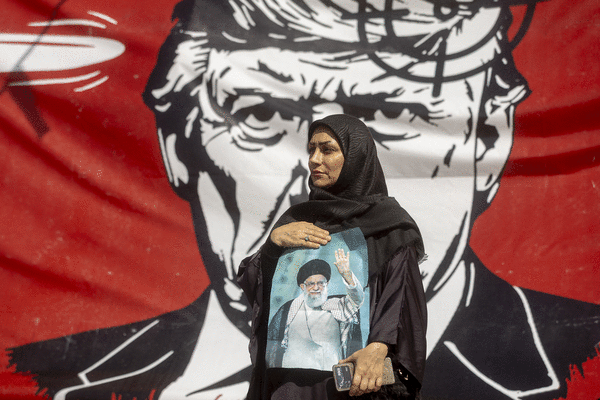
President Donald Trump recently justified renewed military action against Iran by saying Tehran “did not obey what they’re supposed to obey” under a memorandum of understanding intended to halt the fighting. Whether one believes Iran violated that agreement or not, one word deserves closer examination: obey.
In international affairs, nations negotiate. They bargain, threaten, deter, deceive and sometimes violate agreements. But sovereign states do not “obey” another nation’s leader in the way a subordinate obeys a superior. That distinction matters because language often reveals how leaders view both diplomacy and power.
The collapse of the memorandum has already produced predictable consequences. American forces responded with significant airstrikes against Iranian military infrastructure. Iran, in turn, declared itself no longer bound by the agreement and resumed attacks against American and regional targets, with two American soldiers killed during Iranian strikes in Jordan on Friday. Each side insists the other crossed the line first. Each military response becomes justification for the next.
This is the very definition of the fog of war.
The phrase is often associated with battlefield confusion: the uncertainty surrounding intelligence, troop movements and enemy intentions. But there is another kind of fog that can be equally dangerous: the fog created when certainty replaces humility.
History repeatedly demonstrates that wars are often prolonged not because nations lack military strength, but because leaders become convinced they fully understand an adversary’s motivations and believe superior force alone can dictate outcomes. That confidence has repeatedly proven costly.
The United States unquestionably possesses overwhelming military capabilities. Few nations can match its technological sophistication, global reach or ability to project force. Yet military superiority has never guaranteed political success. Vietnam, Iraq and Afghanistan all serve as reminders that battlefield victories do not always produce lasting strategic results.
Iran presents its own challenge. Its leaders have repeatedly demonstrated a willingness to absorb severe economic hardship, diplomatic isolation and military losses in pursuit of objectives they consider vital. That does not make their decisions wise or justified. It simply means they often calculate costs differently than American policymakers expect.
Trump has often found success in chaotic environments by projecting unpredictability to get opponents to back down. Iran’s leaders are showing they can play the same game, using their ability to disrupt traffic in the Strait of Hormuz and showing a willingness to resume hostilities in spite of the consequences in order to gain negotiating leverage.
This is why humility is not a sign of weakness in presidential leadership. It is a strategic necessity.
Humility recognizes that intelligence is imperfect. It acknowledges that adversaries rarely behave according to our assumptions. It accepts that every military strike carries risks that cannot be fully predicted and consequences that may not become apparent for months or years.
The danger arises when national policy becomes intertwined with personal pride. If diplomacy is viewed through the lens of whether another nation has “obeyed” an American president, negotiations risk becoming contests of will rather than efforts to secure American interests. The objective should never be personal validation. It should be national security.
Strong presidents project resolve. Wise presidents also understand the limits of power.
As tensions with Iran continue, Americans should certainly expect firmness from their commander in chief. They should also expect prudence, discipline and a willingness to recognize that even the most powerful nation on earth cannot eliminate uncertainty from war.
The fog of war is unavoidable. The greater danger comes when leaders believe they can see through it perfectly. History suggests otherwise. The strongest leadership has never been defined by confidence alone, but by the humility to recognize that even great powers can miscalculate and that the price of miscalculation is often paid not by presidents, but by the young men and women sent into harm’s way.
_____
©2026 The Baltimore Sun. Visit at baltimoresun.com. Distributed by Tribune Content Agency, LLC.









































Comments