Mark Gongloff: A $5 trillion idea to save energy is hiding in plain sight
Published in Op Eds
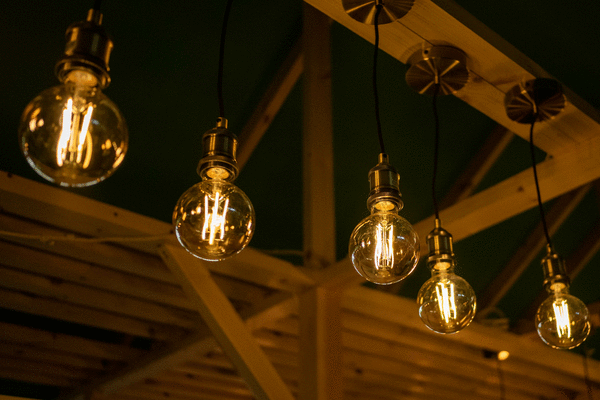
While we’re waiting around for cold fusion, space mirrors, matrioshka brains or whatever other complicated world-savers the tech wizards are cooking up these days to address soaring energy demand, a simple, effective solution is already available. It would create trillions of dollars in economic value and millions of jobs while also eliminating billions of tons of climate pollution and hundreds of thousands of premature deaths.
The major drawbacks are a) it’s too available, scalable and widely distributed for any one Silicon Valley princeling to become a trillionaire from it and b) it is now, weirdly and depressingly, a partisan issue.
This miracle technology is not a new form of energy but simply the magic of using it more wisely. It’s addressing demand rather than supply. The U.S. economy alone could save $4.8 trillion through 2050 by picking an abundance of low-hanging, energy-saving fruit, according to a new report from the American Council for an Energy-Efficient Economy, a nonprofit research group. All of this fruit-picking and money-saving will be an economic boon that could create 1 million new jobs every year.
“The energy system is facing multiple challenges right now. People are hurting from energy costs, and stress on the electrical grid from new data centers and other loads is growing,” report co-author Lowell Ungar, an ACEEE senior fellow, told me. “We wanted to look at what could be done about it from the demand side. Trying to fix energy challenges by throwing more supply at them is like fighting with one hand behind your back. It’s costly and really hard.”
The ACEEE’s demand-side prescriptions are cheap and really easy. They include setting efficiency standards for homes, offices, appliances, vehicles and more. They include making more and better use of stuff like heat pumps, LED lights and smart manufacturing. They include some financial incentives to carry people through what will overall be a shockingly affordable process anyway. They include smarter use of the electric grid to smooth out demand.
All of these run-of-the-mill approaches, in many cases just one technological step up from your dad bugging you to turn the lights off when you leave a room, will lead to less energy demand. Because of Econ 101, this will mean lower energy prices. In some cases, the savings will begin immediately due to lower use of energy and raw materials, meaning the net cost of this demand-side economics will be negative $20 billion from the jump and steadily improve from there, averaging $215 billion in savings per year. This is the money for nothing spoken of in legend.
As a side effect of all this energy non-use, peak US electricity demand will be 440 gigawatts lower by 2050, freeing up the output of about 400 power plants. This will make room for all the electrification homes and businesses will be doing, along with all those data centers being built for profoundly inefficient generative AI and maybe some yet-unknown better technology.
We’ll also burn less fossil fuel in the process, avoiding 22 billion metric tons of carbon emissions through 2050. This would be roughly the equivalent of having Canada and Australia running at net-zero emissions for a quarter-century. Fossil fuel’s air pollution would dwindle, saving about 278,000 American lives, particularly in low-income neighborhoods most often exposed to toxic air.
Sounds almost too good to be true! What’s the catch?
The catch is politics. Since his re-election, President Donald Trump has made saving energy a culture-war battlefield, despite declaring an “energy emergency,” which he then worsened tenfold by thwarting clean-energy projects and turning the Middle East into a semi-permanent war zone. His administration has consistently attacked efficiency standards on the basis that it’s woke to deprive consumers of their right to waste money.
The true beneficiary of all this nonsense is the fossil-fuel industry that helped get him elected and now basically runs the White House.More energy demand equals higher prices equals more money for Big Oil. Unfortunately, at least some momentum for any energy-saving revolution will have to come from the federal government, along with some of the state and local leaders currently pretending that telling people to set their thermostats to 78F (25.6C) during a heat wave is the tip of a Stalinesque spear.
“Left to its own devices, the market is not going to achieve these levels of savings,” Ungar said of the $5 trillion demand-side energy boon. “You need government programs and policies.”
American appliance makers didn’t get serious about making fridges and dishwashers more efficient until the U.S. government launched the EnergyStar program, which set uniform standards and gave consumers easily graspable information about how much money they could save. At a cost of just $32 million per year, EnergyStar saves Americans $40 billion a year.
So naturally Trump tried to kill EnergyStar, which was established by a Republican president. Many Republican lawmakers, along with manufacturers and consumer groups, pushed back hard enough to save the program.
The energy crisis shows no sign of fading as an economic or political issue. Unlike cold fusion, demand-side energy solutions, which have long appealed to moms, dads, Republicans and Democrats alike, are still right there. We need them now more than ever.
_____
This column reflects the personal views of the author and does not necessarily reflect the opinion of the editorial board or Bloomberg LP and its owners.
Mark Gongloff is a Bloomberg Opinion editor and columnist covering climate change. He previously worked for Fortune.com, the Huffington Post and the Wall Street Journal.
_____
©2026 Bloomberg L.P. Visit bloomberg.com/opinion. Distributed by Tribune Content Agency, LLC.




















































Comments