Venezuelans frustrated by earthquake response want new presidential elections
Published in News & Features
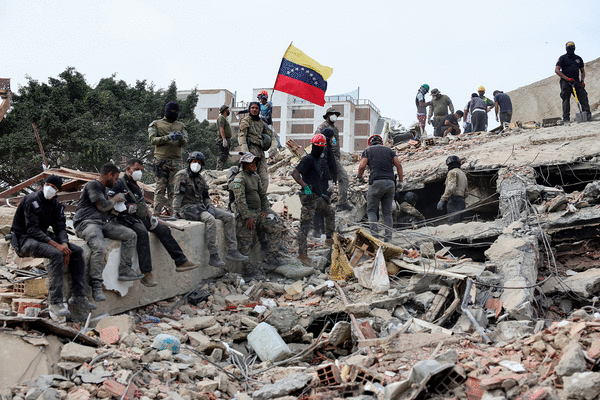
Acting President Delcy Rodríguez is facing mounting political fallout from last week’s twin earthquakes, with nearly half of Venezuelans saying holding new elections is more urgent than rebuilding after the disaster.
Rodríguez’s disapproval rating climbed to 63.3% in June, up almost five percentage points from May, according to an AtlasIntel survey conducted for Bloomberg News between June 26 and 30, after the disaster struck. Nearly two-thirds of respondents disapproved of the government’s handling of the earthquakes, while 52.4% described the response as “very poor.”
Now, some 45.7% of respondents said that electing a new president is a greater priority than the 32.6% who said reconstruction should come first.
Public anger has spilled across social media in recent days, where videos have circulated of Venezuelans criticizing the government’s response time and confronting officials. Authorities have officially reported nearly 2,600 deaths and 12,400 injured. An opposition-backed registry continues to list more than 38,000 people as missing.
“People are very angry with the government for its failure to take the earthquakes seriously and mount an effective response,” said Brian Naranjo, a retired senior U.S. diplomat with experience in Venezuela. “Civil unrest could become a problem.”
He said the response to the earthquakes has already revived civic ties among Venezuelans outside the political sphere, generating a level of community action not seen in years.
One video widely shared across social media shows local volunteers confronting soldiers in a militarized disaster zone, demanding to know why they were carrying rifles instead of picks and shovels. “That uniform is meant to defend the country,” one visibly frustrated man tells the troops as others gather around him. “We’re not at war — we’re facing an emergency.”
Venezuela’s information ministry did not immediately respond to a request for comment. But during a Thursday night press conference with foreign media, Rodríguez said accounts of a slow government response were “largely shaped by narratives that were manufactured in coordinated information campaigns.” She said the state “activated immediately,” but “naturally,” the first people to arrive to fallen buildings were survivors, relatives and neighbors. She also said some remote areas could not be reached “for up to two days“ because roads were blocked.
Since the quakes, state television has showcased government officials’ briefings and visits to affected areas. An earlier timeline broadcast by state-run Venezolana de Television showed that Rodríguez did not address the nation until roughly 90 minutes after the two earthquakes struck, and security forces, emergency medical teams and civil protection units were deployed only afterward.
Another widely shared video shows Interior Minister Diosdado Cabello arguing with international rescue workers after preventing them from entering a devastated area. “There’s somebody right over there crying for help,” one rescuer tells Cabello in the footage. “You don’t want us to help that person over there?”
Days after the confrontation, amid mounting criticism, Cabello’s team said on Telegram that the goal was not to block volunteers but to manage access so aid could reach those most in need.
The survey suggests the disaster has accelerated a crisis of confidence that had been building since Nicolás Maduro’s capture by U.S. forces in January. Anti-government protests had already climbed to 1,926 during the first three months of the year, up from 788 in the same period of 2025, according to the Venezuelan Observatory of Social Conflict. The government hasn’t engaged in the same levels of repression as in the past as it seeks to cooperate with U.S. pressure.
U.S. officials have defended the Rodríguez administration’s response. The interim government’s commitment “hasn’t changed since the earthquake — in fact, it has only grown,” U.S. Chargé d’Affaires in Venezuela John Barrett said in a late-June interview with Univision.
“I have seen complete transparency in my conversations with the interim presidency and a genuine concern for taking care of the people and continuing to work with us,” Barrett said.
Instead, Venezuelans have placed greater confidence in non-state actors than in government institutions during the emergency, according to the survey. Respondents credited doctors, firefighters, private companies, nongovernmental organizations, religious groups and opposition leader María Corina Machado with contributing more to relief and reconstruction efforts than the government, police forces or Rodríguez herself.
“State institutions have not risen to the occasion,” Machado’s team said in a statement Wednesday. “In far too many places, citizens have had to face the hardships of this emergency on their own.”
Machado, who remains in Panama after authorities prevented her from returning to Venezuela, continues to be the country’s highest-rated political leader, with a 53% of respondents having a positive image of her. Still, that was down two percentage points from the previous survey.
With large areas still buried under rubble and hopes of finding survivors fading, desperate Venezuelans have turned to WhatsApp groups to seek help, offering to pay for heavy excavators or crews to clear collapsed buildings. On Thursday, rescue workers pulled a man alive from the debris after he had spent eight days trapped.
Rodríguez herself has also faced public anger. During a visit last week to one of Caracas’s hardest-hit neighborhoods, residents surrounded her, accusing authorities of abandoning them before repeatedly chanting, “Get out!”
AtlasIntel surveyed 2,581 adults across Venezuela beginning two days after the earthquakes. The poll has a margin of error of plus or minus 2 percentage points.
©2026 Bloomberg L.P. Visit bloomberg.com. Distributed by Tribune Content Agency, LLC.


Comments