Larry Snelling's retirement means Chicago police superintendent search begins again
Published in News & Features
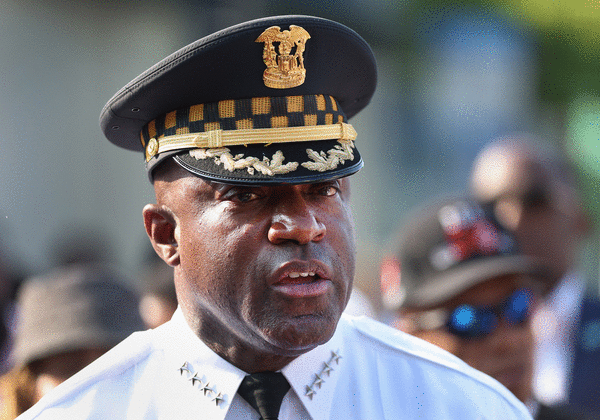
CHICAGO — With the announcement of Chicago police Superintendent Larry Snelling’s retirement later this month, the search for the next head of the Chicago Police Department will soon begin in earnest.
The selection of CPD’s leader is always a high-profile affair — the superintendent is the most public-facing city employee aside from the mayor — but the focus may be even sharper now, with the city’s next mayoral election only eight months away.
The next permanent police superintendent, overseeing a department of more than 12,000 people, will face many of the same challenges posed to their predecessors: tamping down Chicago’s entrenched gun violence, furthering the city’s adherence to the federal consent decree and strengthening partnerships between CPD and city residents.
In the meantime, Mayor Brandon Johnson has selected longtime CPD supervisor Fred Waller to once again serve as interim superintendent, as he did in 2023. A day before Snelling announced his retirement, he promoted Antoinette Ursitti, chief of detectives, to first deputy superintendent.
CPD brass and Johnson administration public safety officials flanked the mayor Thursday afternoon as he walked a Back of the Yards block with young people who work with the anti-violence group Increase the Peace. Neither Snelling nor Waller attended.
Asked about Snelling’s replacement, Johnson praised the outgoing superintendent, then said he would “focus on what I’m always focused on.”
“Having people who understand the full assignment,” he said. “That it’s not policing alone, they play a part, and I’ve worked to improve our detectives bureau to hire and promote more detectives, that work is important, but it also includes someone who understands the value of CVI, community violence intervention, workers.”
Pressed on the politics of the pick, the mayor said he was not worried the February 2027 mayoral election will politicize the process.
“What really has my attention are the working people in this city. We have a diverse city, all of us working together to drive violence down,” he said. “The politics of this city will do what it does. My responsibility is to govern, and we’ve done it.”
The Community Commission for Public Safety and Accountability will, once again, lead the nationwide search. In 2023, the commission’s three finalists for the superintendent position were Snelling; Shon Barnes, the chief of police in Madison, Wisconsin; and Angel Novalez, CPD’s chief of constitutional policing and reform.
Novalez, 53, has overseen many of CPD’s reform efforts in the wake of the 2015 release of the Laquan McDonald shooting video and would likely be considered for the permanent job again if he applied.
Born in Puerto Rico, Novalez moved to Chicago with his family in the 1970s. He joined the department in 2000 and was previously assigned to the Near West (12th) District, the training academy, Area 4 and the Grand Central District (25th) on the Northwest Side.
After he was shot in the line of duty, Novalez quickly rose through the ranks to oversee many of the department’s community-building efforts, including the CAPS program. In recent months, he’s acted as Snelling’s emissary during meetings of the Chicago Police Board.
The department has not had a Latino superintendent since 1997, when Superintendent Matt Rodriguez was forced to resign amid scrutiny of his friendship with a convicted felon.
CCPSA Commissioner Anthony Driver said he and CCPSA President Remel Terry will lead the body’s working group as it proposes nominees. They will once again host listening sessions and focus groups throughout the city, he said.
He declined to comment on specific candidates and said little when pressed on whether Novalez’s background could make him an attractive candidate.
“It wasn’t because he was Latino, it was because he was qualified to be a generational leader at the time,” Driver said. “If he applies, we’ll consider him alongside everybody else.”
Driver predicted the selection process will be completed well before the mayoral election. The contest should have no bearing on the pick, he added.
“Politics being in public safety is part of the problem. Public safety shouldn’t be political, at all,” he said.
Terry called Snelling “the best person I’ve seen in this position” and lauded his connection to the city.
“He didn’t have to learn the ropes,” she said. “We need someone who is going to understand that uniqueness and be present and accessible.”
Input from everyday Chicagoans must be the focus as a new superintendent is selected, she said.
“This will not be a quick process, and we would like for there to be patience,” she said.
Driver joined the chorus of praise for Snelling. The superintendent stabilized the department after Brown’s rocky tenure and made a once-tense relationship with the oversight board an effective collaboration, he said.
Snelling rose through the ranks and would never give an order he himself would not take, he said. Driver described him as a “workhorse” who knew every inch of the department and stayed after police community meetings to listen to Chicagoans until a building manager forced him to leave.
“He was a person who wasn’t swayed by political headlines. … It’s rare you find a person that has that level of integrity in any role in Chicago that high up,” Driver said. “There’s hundreds of young Black men my age who are probably alive because we have a better public safety system.”
Ald. Andre Vasquez, 40th, chair of the City Council’s Latino Caucus, said “there’s a lot to be desired” in ensuring adequate representation across top city leadership positions.
“I think that it is something to pay attention to, but our priority — like everybody else — is making sure Chicago is safe,” he said.
Vasquez, too, praised Snelling for his willingness to talk and his rise through the ranks. The two sometimes disagreed on policy, but the superintendent engaged with honesty and thoughtfulness, Vasquez said.
“He says he’s no politician, but it’s very clear he understands the importance of conversations and relationships,” he added.
The CCPSA must be allowed to carry out a full process, even amid pressure to quickly find a permanent pick, Vasquez said.
“I think this is why we were all shooting for the CCPSA to be the ones to decide and not a mayor,” he said. “Right now what Chicagoans need is stability and sound decision-making, not more circus.”
_____
©2026 Chicago Tribune. Visit chicagotribune.com. Distributed by Tribune Content Agency, LLC.




Comments